From AI Pilots to Governed Growth: A Board-Level Playbook
This article draws on findings fromPwC’s 2026 AI performance study, “Want ROI from AI? Go for growth,” based on responses from 1,217 senior executives across 25 sectors.
Across boardrooms, artificial intelligence has moved from an emerging technology discussion to a standing business priority. Most organizations now have an expanding portfolio of AI initiatives: copilots, customer-service assistants, automated assessments, decision engines and experimental agents.
The activity is encouraging. The returns are less consistent.
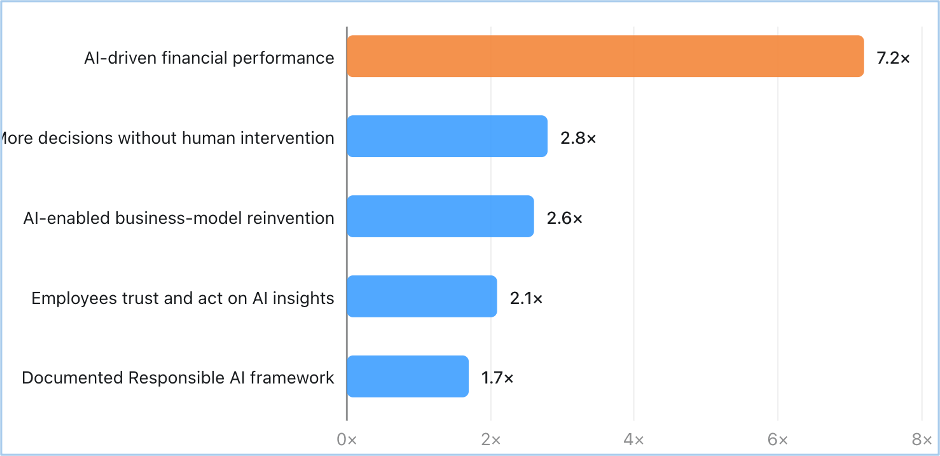
PwC’s recent AI performance study highlights the scale of the divide. Just 20% of the 1,217 companies surveyed capture 74% of the reported value generated by AI. The most “AI fit”companies deliver AI-driven financial performance - revenue and efficiency gains - that is 7.2 times higher than that of their peers.
The difference is not simply access to better technology. Nor is it the number of pilots underway.
Leading organizations are better at directing AI towards meaningful business outcomes, establishing the foundations required to use it responsibly and embedding successful solutions into everyday operations. In short, they have learned how to convert experimentation into governed growth.
That conversion should now be a board-level priority.
The pilot paradox
AI pilots are relatively easy to launch. A motivated team can select a tool, identify a problem and produce a promising demonstration in weeks. Yet a successful demonstration is not the same as a scalable business capability.
As pilots move into production, the difficult questions emerge:
- What data is the system using, and is that use authorized?
- Who is accountable for its decisions and outcomes?
- How will the organization identify bias, drift or inaccurate output?
- What happens when the model, vendor or regulatory environment changes?
- Can the controls be demonstrated to customers, auditors and regulators?
- Is the initiative delivering measurable value?
-
When these questions remain unanswered, pilots accumulate without progressing. Some become permanently experimental. Others enter business workflows informally, creating shadow AI, duplicated expenditure and unmanaged exposure. The organization may appear busy withAI while remaining unable to demonstrate either control or return.
Boards therefore need to change the question.
Instead of asking, “How many AI pilots do we have?”, they should ask,“How many AI capabilities can we responsibly scale - and what measurable outcomes are they producing?”
Governance is an enabler of return
Governance is often characterized as a constraint: a layer of policies, approvals and compliance checks applied after innovation has taken place. That view is increasingly outdated.
Effective AI governance creates the conditions for faster, more confident adoption. It clarifies which uses are permitted, which require additional scrutiny and which exceed the organization’s risk appetite. It gives teams repeatable assessment methods instead of forcing every initiative to navigate a new approval process. It also provides leaders with the evidence needed to decide whether to scale, redesign or stop an initiative.
PwC found that AI-leading companies are 1.7 times more likely to use a documented Responsible AI framework and 1.5times more likely to have a cross-functional AI governance board. Their employees are also 2.1 times more likely to trust and act on AI-generated insights.
That connection matters. AI produces little value when employees do not trust it, leaders cannot defend it and risk teams cannot see it.
Governance should not eliminate uncertainty; no framework can do that. Its purpose is to make uncertainty visible, assign accountability and keep risk within deliberate boundaries. When implemented well, it becomes part of the organization’s AI operating system - nota checkpoint at the end of development.
Six questions every board should ask
Boards do not need to manage individual models or approve every use case. They do need sufficient visibility to oversee whether AI investment is aligned with strategy, risk appetite and organisational obligations.
Six questions can move the conversation from experimentation to governed growth.
1. Which business outcomes are we pursuing?
Every significant AI initiative should be linked to a defined business objective. That could be revenue growth, customer retention, faster product development, improved decision quality, reduced processing time or more effective risk detection.
PwC’s research suggests that leading organizations distinguish themselves by using AI not only to reduce costs, but also to reinvent offerings and identify new sources of growth. They are 2.6times more likely to report that AI has improved their ability to reinvent their business model.
This does not mean every project must transform the company. It does mean that “using AI” is not, by itself, a strategy.
The board should expect management to define the intended value, establish a baseline and identify how success will be measured. If the outcome cannot be articulated, the investment case is not yet mature.
2. Do we know where AI is being used?
An organization cannot govern what it cannot see.
Its AI inventory should extend beyond internally developed models. It should include embedded AI features in existing software, third-party platforms, employee-selected tools, automated decision systems and emerging agentic applications.
For each use case, leaders should understand its purpose, owner, users, data dependencies, vendor relationships and level of autonomy. The inventory must also be treated as a living record. A spreadsheet assembled for an annual audit will quickly become obsolete in an environment where tools and models change continuously.
Without this visibility, boards may receive assurance about the official AI program while significant risks are developing elsewhere in the organization.
3. Who owns the outcome - and who owns the risk?
AI governance fails when accountability is distributed so broadly that nobody is genuinely responsible.
Every priority initiative should have a named business owner accountable for its value and operational performance.Technical teams should be responsible for system reliability and implementation. Security, privacy, legal, compliance and risk specialists should define and test the relevant safeguards.
A cross-functional governance body can coordinate these responsibilities, resolve difficult cases and establish enterprise standards. But it should not become a substitute for individual accountability.
The board should be able to identify who has the authority to approve an AI system, who monitors it and who can suspend it when performance or risk moves outside acceptable limits.
4. What decisions may the AI make?
The rise of AI agents makes this question increasingly urgent.
There is a material difference between a system that drafts a recommendation, one that makes a decision and one that acts autonomously across multiple systems. These levels require different controls, evidence and human oversight.
PwC reports that AI performance leaders are 2.8 times more likely to increase the number of decisions made without human intervention. Yet full autonomy remains limited: only 15% of the leaders surveyed said their most sophisticated AI use case was autonomous and self-improving.
Boards should not interpret this as a race towards maximum autonomy. The objective is appropriate autonomy.
A sensible progression begins with high-frequency, repeatable and measurable decisions carrying low to moderate risk. Authority can expand only when the organization has evidence that the system is reliable, secure and operating within established guardrails.
For each use case, leaders should define what the AI may decide, when a human must intervene and what conditions trigger escalation or shutdown.
5. Are our foundations strong enough to scale?
AI programs often stall because the surrounding environment cannot support them. Common barriers include poor data quality, unclear access rights, fragmented technology, inconsistent risk assessments and the repeated creation of similar controls.
PwC found that companies combining increased AI use with strong foundations experience nearly twice the performance improvement achieved by organizations with weaker foundations.
The lesson is not that every enterprise must complete a vast transformation before scaling AI. Leaders should build the foundations required for their highest-value use cases.
That may include trusted data, role-based access, secure experimentation environments, standard documentation, reusable control libraries, vendor assessment processes and continuous monitoring. Frameworks such as ISO/IEC 42001 and the NIST AI Risk ManagementFramework can provide structure, but they must be translated into practical workflows, responsibilities and evidence.
The goal is repeatability. Each successful deployment should make the next one faster and more reliable.
6. Do we know when to scale - and when to stop?
AI portfolios require active management. Continuing to fund a project because it is innovative, visible or politically supported is not disciplined investment.
PwC notes that leading companies are 80% more likely to systematically track the business impact of AI initiatives.Yet even among those leaders, only 28% report conducting portfolio reviews to terminate initiatives to a large or very large extent.
Boards should expect a regular “scale, change or stop” review. Each initiative should be assessed against agreed measures covering business impact, adoption, performance, risk and control effectiveness.
Projects that demonstrate value and remain within risk thresholds can receive additional investment. Those with potential but inadequate controls can be redesigned. Those producing neither credible value nor strategic learning should end.
Stopping an initiative is not necessarily failure. Continuing without evidence is.
A practical board dashboard
Boards need concise, decision-relevant information rather than pages of technical metrics. A useful AI governance dashboard could include:
- The number of known AI use cases, segmented by risk and lifecycle stage
- The proportion with named business and risk owners
- Benefits achieved against the approved business case
- Adoption and decision-quality measures
- High-risk systems awaiting review or remediation
- Material security, privacy, compliance or performance incidents
- Third-party AI concentration and dependency risks
- Systems operating with autonomous decision-making authority
- Control exceptions, overdue assessments and unresolved findings
- Recommendations to scale, change or stop priority initiatives
The dashboard should reveal trends and exceptions. Its purpose is not to suggest that every risk can be reduced to a traffic light. It is to help directors understand whether AI adoption is advancing under control - and whether investment is producing results.
From oversight to advantage
The organizations capturing disproportionate value from AI are not simply experimenting more aggressively.They are creating an environment in which successful experimentation can become dependable execution.
For boards, this requires balancing ambition with evidence. Excessively restrictive governance can drive AI use underground or delay worthwhile innovation. Weak governance can allow unmanaged systems to spread until a security incident, regulatory inquiry or customer failure forces intervention.
The better path is risk-based governance: clear rules for routine uses, deeper scrutiny for consequential applications and continuous oversight as systems evolve.
This is where governance becomes a source of strategic advantage. It gives employees confidence to use approved systems. It enables executives to allocate capital more effectively. It helps customers and regulators trust how AI is deployed. Most importantly, it allows the organization to scale value without scaling uncertainty at the same rate.
The next phase of enterprise AI will not be won by the organization with the longest list of pilots. It will be won by those that can identify the right opportunities, govern them proportionately and embed successful systems into the decisions and workflows that drive the business.
For boards, the mandate is clear: stop counting AI activity and start governing AI outcomes.